





Chair
Director General,
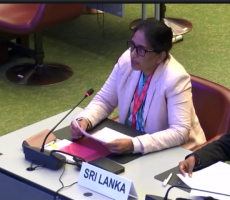
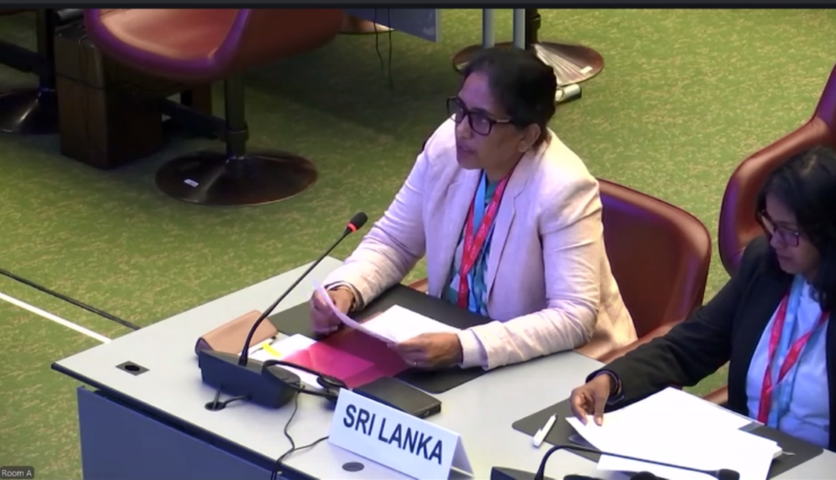
Thank you for giving me the floor.
At the outset allow me to convey Sri Lanka’s deep appreciation to IOM for its solidarity and rapid humanitarian support in the aftermath of the destructive cyclone Ditwah which devastated Sri Lanka last month, causing huge loss of life and vast scale damage to property, and infrastructure.
As multiple global crises and challenges continue to compel migration within and across borders, we are witnessing increased hostility against migration compounded by misguided and damaging narratives. In contrast, safe, orderly and regular migration brings many fold opportunities for all, benefitting migrants, countries of origin and destination.
Sri Lanka emphasizes the continued relevance of international migration governance, providing the framework for regular migration. In this context, the strategic leadership of IOM in the framework of international migration governance remains critical, more than ever.
Sri Lanka takes this opportunity to commend the proactive approach of IOM in ensuring the effective implementation of its mandate, and the strategic objectives. At a time where deliberate attempts are made to weaken multilateralism, and multilateral institutions are burdened with severe liquidity crisis, Sri Lanka appreciates the IOM’s sustained and innovative efforts to address these impacts, in close consultation with member states.
As a longstanding partner Sri Lanka is pleased to have contributed to the IOM Resilience Fund aimed at preserving its core capacity and structure.
Chair
Promoting safe, orderly, regular and rights-based migration remains a priority for Sri Lanka. The Government’s commitment is manifested through several progressive policies, and initiatives have been implemented nationally to safeguard the migrants and their families, ensuring their welfare, including through the recent national Budget for 2026.
We deeply value our long-standing constructive partnership with IOM. At IOM’s invitation, Sri Lanka joined the GCM Champion initiative in April 2025. Recognizing the evolving migration dynamics and Sri Lanka’s status as a GCM Champion Country, a new National GCM Implementation Plan for 2026–2028 is currently being developed through a series of multi-stakeholder consultations. Further, the Migration and SDGs Monitoring Platform (MSMP), a new digital tool to track migration’s contribution to the SDGs, was launched by the Government of Sri Lanka in November 2025. These measures aim at strengthening our migration governance framework and contribute to the achievement of SDGs.
As the 2nd IMRF approaches Sri Lanka looks forward to being engaged in this process. In conclusion, we reiterate our commitment to continued collaboration with IOM to promote our common objectives furthering migration governance benefitting all.
Thank you.
Allow me at the outset to thank the UN Network on Migration and the Permanent Mission of Ecuador for organizing this event. We are particularly pleased to participate in this dialogue, having joined the GCM Champions Initiative in March this year.
115th Session of the IOM Council
Regular Migration Pathways: A Global Call for Action
High Level Segment - 26 November 2024

Chair
Director General of IOM
Excellencies
International Dialogue on Migration – 2020
Panel 2: Protection of vulnerable migrants during and beyond the COVID-19 crisis.
Statement by Sri Lanka
15 October 2020
Mr Antonio Vittorino, DG/IOM
Excellencies and Colleagues
The focus of this panel on the protection of vulnerable migrants during and beyond the COVID-19 pandemic is not only timely but a present necessity. It is our hope that this discussion will lead to a better understanding of the issues, challenges and gaps in providing protection and assistance to this group, and result in stronger cooperation between Governments and other stakeholders in the development of policies, practises and networks ensuring greater assistance and protection for vulnerable migrants during the present pandemic and beyond.
Migrant workers comprise 3.5% of the world’s population and are a crucial part of the global workforce. The contribution of migrant workers to economic growth and development has become critical not only for the countries of origin, but also for upward socioeconomic mobility in the region and internationally.

Speaking at the General Debate of the 70th session of the Executive Committee of the United Nations High Commissioner for Refugees (UNHCR), Ambassador A.L.A. Azeez, Permanent Representative of Sri Lanka, outlined measures taken by Sri Lanka to address the issue of statelessness. The meeting, chaired by Ambassador Boudjemâa Delmi of Algeria, takes place from 7-11 October 2019, with the participation of Mr. Filippo Grandi, the UN High Commissioner for Refugees.

Full Statement by Ambassador Azeez
Permanent Mission of Sri Lanka
Geneva
09th October 2019

At the 2019 Global Appeal of the United Nations High Commissioner for Refugees (UNHCR) held in Geneva today, Sri Lanka expressed its earnest desire that the commitments made by the international community to the recently adopted Global Compact on Refugees (GCR) would remain on course, emphasizing “transforming the Compact into meaningful, practical measures would help address the protection needs of millions of people who remain helpless and in need”.
Addressing the Conference, Ambassador A.L.A. Azeez, the Permanent Representative of Sri Lanka in Geneva echoed optimism that, at a time when “the principles and values of international cooperation have come under immense pressure”, “the GCR has emerged as a rallying point for multilateralism and solidarity”, as reiterated in the UNHCR’s Global Appeal Update, and highlighted the more pronounced role of UNHCR in this context.

“The Global Compact for Migration (GCM)” due to be endorsed at a high level international conference in Marrakesh in December this year, Ambassador A.L.A. Azeez, Sri Lanka Permanent Representative in Geneva said “is not the end –but the beginning of the real work”. He made this remark, addressing the General Debate of the ongoing 109th Session of the IOM Council in Geneva. He urged all countries, ‘especially those which have for decades valued and sustained migration as a source of national economic advancement,’ to unreservedly endorse the GCM’, as ‘it has now left us with an integrated framework for action.’
Assuring that Sri Lanka, in its national capacity, and both as the Chair of the Abu Dhabi Dialogue (ADD) and the founder member of the Colombo Process (CP) - would endeavour in the best possible way to take the GCM processes forward, he emphasized the importance of the implementation of the Global Compact by all stakeholders. He further said that Sri Lanka looked forward to contributing actively to the discussion on the modalities for follow-up and review of progress in the Global Compact early next year. The GCM, Ambassador Azeez noted, was rooted in achieving SDG’s, adding that it was important to look at how effectively implementation of commitments could take place taking into account the respective regional dynamics and priorities.