
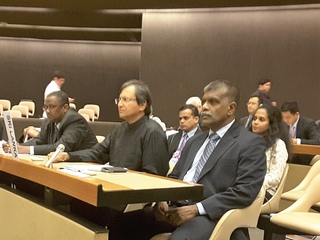
Sri Lanka participated in the 7th Meeting of the Convention on Cluster Munitions (CCM) entered into force in August 2010, held in Geneva on 4-6 September 2017, which opened today.
The attached statement was delivered by Sri Lanka’s Permanent Representative to the UN in Geneva Ravinatha Aryasinha.
Convention on Cluster Munitions (CCM) is an international treaty that addresses the humanitarian consequences and unacceptable harm to civilians caused by cluster munitions, through a categorical prohibition and a framework for action. The Convention prohibits all use, production, transfer and stockpiling of cluster munitions. In addition, it establishes a framework for cooperation and assistance to ensure adequate care and rehabilitation to survivors and their communities, clearance of contaminated areas, risk reduction education and destruction of stockpiles.
Sri Lanka’s delegation included Major General D S Weeraman psc, Brigadier W A N M Weerasinghe RSP USP and Ms. Dulmini Dahanayake, Second Secretary of the Sri Lanka Permanent Mission in Geneva.
4 September 2017
Sri Lanka Permanent Mission
Geneva

Sri Lanka said that it supports the establishment of a Group of Governmental Experts (GGE) on Lethal Autonomous Weapons Systems (LAWS) in 2017, within the framework of the Convention on Certain Conventional Weapons (CCW) and to elevate the dialogue on LAWS to a State –driven formal process.


Sri Lanka's Ambassador to the UN in Geneva Ravinatha Aryasinha expressing concern on the slow progress made over the decades on international multilateral nuclear disarmament efforts, has affirmed Sri Lanka’s support for the convening of a conference in 2017, to negotiate a legally – binding instrument to prohibit nuclear weapons, leading towards their total elimination. Sri Lanka further noted that the agreement on such a negotiation would ensure the fulfillment of the wish of the UN membership at large.
He made these observations during an intervention by Sri Lanka at the third and final session of the General Assembly mandated Open – Ended Working Group (OEWG) on Taking Forward Multilateral Nuclear Disarmament Negotiations, held in Geneva last week. During its final plenary meeting held on 19th August 2016, the Group adopted the report by vote, and recommend to the General Assembly to convene a Conference in 2017, to negotiate a legally – binding instrument, to prohibit nuclear weapons, leading towards their total elimination. The recommendation, which will be assessed by the General Assembly, is seen as a significant step towards nuclear disarmament.

Referring to the arguments made by some that “nuclear weapons are not illegal as per se and that the UN Charter has not excluded the possibility of using nuclear weapons in self – defense”, Sri Lanka said that such “existing lacuna in international law for not explicitly prohibiting nuclear weapons should not be taken as a cover to legitimize nuclear weapons, instead we should take it as a catalyst to work collectively in order to close the gaps and strengthen the international law.”
Sri Lanka’s Deputy Permanent Representative to the UN in Geneva, Mrs. Samantha Jayasuriya made these remarks on 11th May 2016 at the second session of the Open – Ended Working Group (OEWG) on Taking Forward Multilateral Nuclear Disarmament Negotiations, held in Geneva from 2-13 May 2016. She further added that a ‘step –by –step’ approach with an undefined ‘final stage’ tends to lose the momentum, and that any “undue delays in taking proactive actions or having to wait until a minimum threshold point is fulfilled by all nuclear possessing States, compromises the rights of States who are not relying on nuclear weapons for their security, and are being subjected to unfair risk of nuclear weapon detonations, accidental or intentional.”


Sri Lanka has cautioned that the potential military advantages of Lethal Autonomous Weapon Systems (LAWS) would risk proliferation and thereby lower the threshold of the rules of warfare, undermining regional as well as global stability. Sri Lanka also alerted on the risk of non-state actors gaining access to such weapons and the potential breach of cyber security in the autonomous technology used in weapons systems.
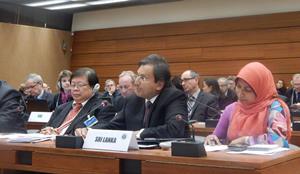
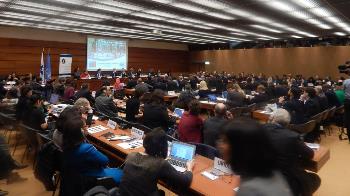
Sri Lanka’s Permanent Representative Ambassador Ravinatha Aryasinha said on Wednesday (2 March 2016) that the Cabinet of Ministers earlier the same morning had approved that Sri Lanka accedes to the ‘Convention on the Prohibition of the use, stockpiling, production and Transfer of Anti-Personnel Mines and on Their Destructions’, which is commonly known as the ‘Ottawa Convention’.
Ambassador Aryasinha made this announcement when he addressed the First International Pledging Conference for the Implementation of the Anti – Personnel Mine Ban Convention on the theme “Mine Free World by 2025: The Last Stretch”, held yesterday (2 March 2016) at the Palais des Nation in Geneva. The pledging conference was organised by the Office of the UN in Geneva and the Government of Chile marking seventeen years of success and calling on all parties to redouble their efforts to meet the humanitarian goals set by the Convention by 2025.
- CCW MEETING TAKES FORWARD MANDATE ON LETHAL AUTONOMOUS WEAPONS SYSTEMS AND PAVES THE WAY FOR 2016 FIFTH REVIEW CONFERENCE
- Sri Lanka says a dialogue among States should be at the center of any future discussion on Lethal Autonomous Weapons Systems
- Ambassador Aryasinha presides over the 2015 Meeting of the Convention on Certain Conventional Weapons (CCW)