

Intervening in the interactive dialogue with the Special Rapporteur on Violence against Women and SR on Extreme Poverty at the 26th UN Human Rights Council in Geneva on 12th June 2014, Sri Lanka said “We believe that in national policy formulation to combat violence against women, it is necessary to focus on gender equality and the empowerment of women to enable them to fully enjoy their human rights and fundamental freedoms. Sri Lanka’s national policy framework, has consistently highlighted the importance of gender equality and taken measures to alleviate any existing gender gaps”.
Intervening in the interactive dialogue with the Special Rapporteur on Right to Health and WG on Human Rights and Business at the 26th UN Human Rights Council in Geneva on 11th June 2014, Sri Lanka has said “Multi-sectoral approach should be used to address diet-related Non-Communicable Deceases (NCDs) and to increase availability of healthier food alternatives through policy formulation. While providing information about the ill effects of unhealthy foods and raising awareness of the benefits of balanced diets and healthy foods, States should take steps to implement health education programmes to promote healthy food options in such institutional settings such as schools”.
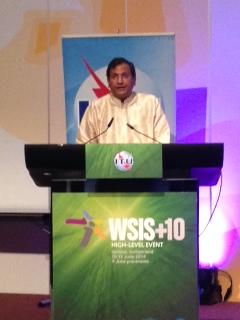
Ambassador Ravinatha Aryasinha, Sri Lanka's Permanent Representative to the UN in Geneva and Chairman of the Personal Representatives of the Group of Fifteen (G-15), has urged all WSIS+10 stakeholders to play a greater role in ensuring the inclusiveness of information society. He particularly drew attention to “the emergence of a new digital divide, especially in terms of quality of ICT infrastructure, broadband access, affordability and digital content, particularly in low-income countries, and stressed that it was “extremely important that the overall review of WSIS processes gives highest priority to the challenges in a balanced and equitable manner.”
Ambassador Aryasinha made these observations when he delivered a joint statement at the High Level Meeting of WSIS+10 (World Summit on Information Society) at CICG in Geneva on 11 June, 2014, on behalf of G-15, a Summit Level Group of Developing Countries comprising 17 member States - Algeria, Argentina, Brazil, Chile, Egypt, India, Indonesia, Iran, Jamaica, Kenya, Malaysia, Mexico, Nigeria, Senegal, Sri Lanka, Venezuela and Zimbabwe.

Sri Lanka has reiterated its categorical rejection of the Human Right Council Resolution 25/1, and said it will not cooperate with the OHCHR-driven so called “comprehensive investigation” emanating from it. Sri Lanka has observed that the Government is firmly committed to continuing its ongoing processes of reconciliation, nation building and accountability, and towards this end, will continue to work with countries and intergovernmental and non-governmental organizations that are genuinely interested in the welfare of the Sri Lankan people.


Hon. Gamini Lokuge, Minister of Labour and Labour Relations has said Sri Lanka prepared a comprehensive National Human Resource and Employment Policy and its Work plan after having had extensive discussions with all relevant stakeholders including trade unions and employer representatives with the blessing of the President of Democratic Socialist Republic of Sri Lanka, His Excellency Mahinda Rajapaksa.

“The G-15 remains convinced that the eradication of forced lablour is essential for the full enjoyment of human rights and human dignity. In this vein, the G-15 is committed to cooperate within the ILO and other agencies to combat this unlawful practice which accounts for the nearly 21 million souls that continue to be silent victims of this scourge.

Minister of Health and Vice President of the 67th World Health Assembly, Maithripala Sirisena, addressing the World Health Assembly today (20th May 2014) said “the World Health Assembly has a historic opportunity to once again appeal to the world community to demand those countries releasing large amount of carbon-dioxide and offensive gases to the atmosphere - to adopt carbon free energy sources to run their industries. These developed nations should be held responsible for releasing large quantities of offensive gases, and the people in developing and poor countries are the victims that have to bear the consequences. Let us all be eco-centered rather than ego-centered so that we can all live happily and with good health and leave to the future generations a much better and a healthy place to live in.