
Your Excellency President Miguel Diaz-Canel Bermudez,
Excellencies:
Cuba for many decades has stood as a champion for the concerns and aspirations of developing nations within various multilateral fora. In that spirit, President Miguel Diaz-Canel Bermudez has convened this timely Summit of the Leaders of the G77 and China. I join with the other delegates in congratulating him.
Let me also join the previous speakers who have extended their deepest condolences to the Government and people of the Kingdom of Morocco and of the State of Libya for the recent natural disasters and extensive loss of lives.
This year, Cuba assumes the Presidency of the G77 at a crucial time when the global South is impacted by multiple and interlocking challenges related to pandemics, climate change, food, fertilizer and energy crises which paved the way for setbacks to the SDGs and a deepening global debt crisis.
In the 15th century, Asia was the most technologically developed region. Europe had advanced only in a few sectors including Gunpowder, Canon, and Ocean-going ships. These three technologies helped Europe to conquer the rest of the world. The conquest of Asia and Africa set back the development of Science and Technology in our countries creating the technological divide of today. Another quantum leap in technology and innovation is taking place in the 21st Century at a geometrical progression further widening the existing technological divide leading to the marginalisation of the South.
There are two key factors essential for the developing nations to come out of these crises. The first, is Digitalization and the adoption of New Technologies. eg. Big Data, IoT, AI, Blockchain, Biotechnology, and Genome Sequencing. The second is, ensuring human resources skilled in the multifaceted fields of Science and Technology. An educated manpower well equipped with knowledge and technological know-how is necessary to keep the smooth flow of the needed transformations. These two factors single-handedly will lubricate the development and catching up process in developing nations.
Let me outline the measures my government is taking. Our continuing economic restructuring process after the financial crisis 2022, provides us with a chance to harness the potential of science, technology, and innovation to our future trajectory of sustainable development and high growth.
We are currently evaluating the performance of all our existing Science and Technology Research Institutes, some of which are under-performing. To promote the utilising of New Technologies for Sri Lanka’s growth, the Government will establish a Technology and Innovation Council as well as a Digital Transformation Agency. Our universities currently do not have the capacity to create the requisite number of technology specialists. Therefore, we will establish four new Universities focusing on the new technologies. One of these is the outcome of the technological cooperation between India and Sri Lanka. The fifth will be establishing the International Climate Change University.
The digital divide presents significant challenges to development in the Global South. These include,
limited access to costly technology,
inadequate digital skills and infrastructure
cultural and institutional barriers, and
financing constraints
Global trade barriers further compound these issues. To overcome these challenges, the G77 & China must establish effective mechanisms for cooperation. Otherwise our endeavours will be limited to words.We must immediately reinvigorate the Consortium of Science & Technology & Innovation for the South (COSTIS). This will be the test of our commitment. In addition, a revised Programme of Action with many of the proposed new measures is required. These measures should include,
Collectively creating technological platforms modeled on the European Union’s Technology & Innovation Platforms in the following fields: Digitalization, Health and Medication, AI and Renewable Energy including Green Hydrogen.
Interested G77 countries must make a commitment to earmark 1% of their GDP for R&D. This has to be achieved over a decade, and
we must foster collaboration between the governments and the private sectors.
The brain drain from the South to the North and the resulting loss of educated manpower, is another threat to the development of Science, Technology and Innovation of the South. China, India Japan and South Korea have developed Science, Technology and Innovation by nurturing their manpower. Therefore, we must ask for compensation from the North for the loss of our manpower.
Strengthening South-South cooperation can also play a significant role in addressing the critical issues of expanding our human resources. Sri Lanka urges the Group of 77 and China to work together to introduce a scheme similar to the Colombo Plan to increase collaboration, exchange best practices, and push policies that harness the transformational potential of science, technology, and innovation.
Sri Lanka is committed to supporting the new Havana Declaration. We must ensure that the collective voice of G77 and China is heard in the international fora.
In conclusion, let me once again thank President Miguel Diaz-Canel Bermudez and the Government of Cuba for your generous hospitality and excellent arrangements.
Thank you.

Eleventh Meeting of States Parties to the Convention on Cluster Munitions 11 – 14 September 2023
Statement by Sri Lanka
Agenda Item 8: General Exchange of Views
Thank you Mr. President,
Sri Lanka joins other delegations in congratulating you for assuming the Presidency of the Eleventh Meeting of States Parties to the Convention on Cluster Munitions. I wish to assure you of my delegation’s fullest support towards a productive outcome of our deliberations. We also warmly welcome Nigeria and South Sudan as the 111th and the 112th States Parties to the Convention. This is an important step towards universalization of the Convention.
Mr. President,
As a country which has never used, developed, produced, acquired or stockpiled Cluster Munitions even during the time of a brutal terrorist conflict, Sri Lanka wishes to reiterate its strong and enduring commitment to realizing the core objectives of the Convention inter alia ‘to put an end for all time to the suffering and casualties caused by cluster munitions’.
We consider that the Convention on Cluster Munitions is a significant disarmament treaty adopted by more than half of the world in the past decade, with far-reaching obligations.
Eleventh Meeting of States Parties to the Convention on Cluster Munitions 11 – 14 September 2023
Statement by Sri Lanka
Agenda Item 8: General Exchange of Views
Thank you Mr. President,
Sri Lanka joins other delegations in congratulating you for assuming the Presidency of the Eleventh Meeting of States Parties to the Convention on Cluster Munitions. I wish to assure you of my delegation’s fullest support towards a productive outcome of our deliberations. We also warmly welcome Nigeria and South Sudan as the 111th and the 112th States Parties to the Convention. This is an important step towards universalization of the Convention.
Mr. President,
As a country which has never used, developed, produced, acquired or stockpiled Cluster Munitions even during the time of a brutal terrorist conflict, Sri Lanka wishes to reiterate its strong and enduring commitment to realizing the core objectives of the Convention inter alia ‘to put an end for all time to the suffering and casualties caused by cluster munitions’.
We consider that the Convention on Cluster Munitions is a significant disarmament treaty adopted by more than half of the world in the past decade, with far-reaching obligations.
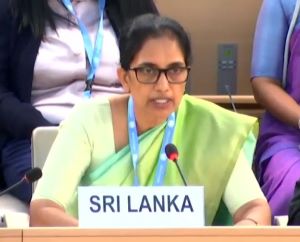
54th Session of the Human Rights Council
Agenda Item 2 - General Debate
Statement by Her Excellency Himalee Arunatilaka, Ambassador and Permanent Representative of Sri Lanka to the United Nations in Geneva
13th September 2023
Mr. President,
Resolutions 60/251 and 48/141 require that the work of this Council and the OHCHR should be guided by the principles of universality, impartiality, objectivity and non-selectivity, and constructive international dialogue and cooperation.
54th Session of the Human Rights Council
Agenda Item 2 - General Debate
Statement by Her Excellency Himalee Arunatilaka, Ambassador and Permanent Representative of Sri Lanka to the United Nations in Geneva
13th September 2023
Mr. President,
Resolutions 60/251 and 48/141 require that the work of this Council and the OHCHR should be guided by the principles of universality, impartiality, objectivity and non-selectivity, and constructive international dialogue and cooperation.
Unfortunately, this does not appear to be the case with regard to Sri Lanka.
One such instance in the Written Update is the reference to the investigations on the Easter Sunday Attacks of 2019. It is regrettable that the OHCHR has sought to use incorrect and unsubstantiated information from biased sources in their analysis. As Sri Lanka has repeatedly informed this Council, extensive and comprehensive investigations have been carried out by the GoSL with regard to these attacks including a Presidential Commission of Inquiry, the report of which was submitted to the Parliament. Investigations carried out by the Government authorities were assisted by international professional agencies including the Australian Federal Police, the FBI of the United States and INTERPOL.

The written update on Sri Lanka was presented at the 54th Session of the Human Rights Council that commenced on 11 September 2023 in Geneva by the Deputy High Commissioner for Human Rights Nada al-Nashif.
Delivering Sri Lanka´s statement as the country concerned, Permanent Representative of Sri Lanka to the United Nations in Geneva, Ambassador Himalee Arunatilaka at the outset reiterated that Resolutions 46/1 and 51/1 were adopted by a divided vote in the Council where the majority of the Member States either opposed or abstained from voting on these Resolutions, in fundamental disagreement with its unacceptable content, in particular the so-called evidence gathering mechanism, the establishment of which is unprecedented.
Sri Lanka rejected the written update by the High Commissioner for Human Rights titled ‘Situation of Human Rights in Sri Lanka’ together with its conclusions and recommendations, while reaffirming its commitment to pursuing tangible progress through domestic institutions.

GoSL Statement made by H.E. Himalee Arunatilaka, the Permanent Representative of Sri Lanka to the United Nations in Geneva
54th Session of the Human Rights Council:
Report on Sri Lanka by the High Commissioner for Human Rights
pursuant to HRC Resolution 51/1
11 September 2023
Mr. President,
At the outset, let me reiterate that the Government of Sri Lanka (GoSL) has consistently rejected Resolution 46/1 and 51/1 that led to the setting up of the so-called ‘Accountability Project’. We also reject the written update, its conclusions and recommendations.
We recall that the majority of the Member States either opposed or abstained from voting on these Resolutions, in fundamental disagreement with its unacceptable content in particular the so-called evidence gathering mechanism, the establishment of which is unprecedented. We reiterate that it goes beyond the mandate that Member States conferred on the Council by UNGA Resolution 60/251.
- Fourth Session of the open-ended working group on reducing space threats through norms, rules, and principles of responsible behaviours, 28 Aug – 01 Sep 2023
- The Second Meeting of the Working Group on the Strengthening of the Biological Weapons Convention (BWC), 7-18 August 2023, Palais des Nations in Geneva
- The Second Meeting of the Working Group on the Strengthening of the Biological Weapons Convention (BWC), 7-18 August 2023 Intervention by Sri Lanka on Implementation of Biological Weapons Convention Plan